
The Dad Brain: The Invisible Architecture of Patresence
Becoming a father isn’t just a lifestyle change—it’s a biological rite of passage that physically reshapes the male neural landscape to ensure the survival of the tribe.
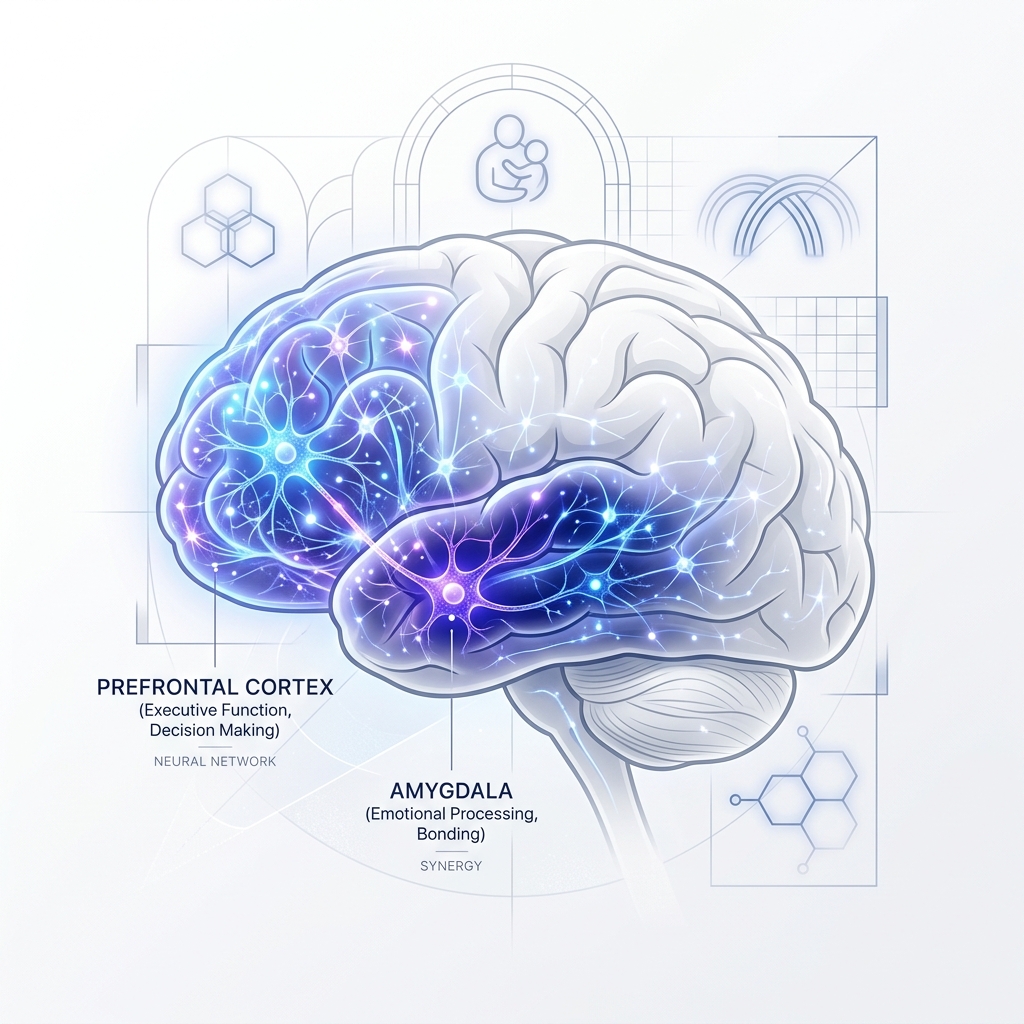
For decades, we have used the term "Matrescence" to describe the profound biological and psychological metamorphosis a woman undergoes when becoming a mother. But for men, the transition has long been framed as purely social—a shift in "responsibility" rather than biology. In 2026, the data has finally caught up to reality. We now know that men undergo a parallel transformation called Patresence. It is an era of radical neuroplasticity where the male brain physically "streamlines" itself, shedding old connections to make room for a new, high-stakes empathy engine.
This isn't just about soft feelings or "baby fever." This is a structural evolution. Longitudinal neuroimaging studies, including landmark 2024 research from the University of Southern California, have confirmed that first-time fathers undergo a physical thinning of the cerebral cortex. We are witnessing the Invisible Architecture of Fatherhood—a process that is as clinically significant as it is emotionally profound.
The Structural Blueprint: Synaptic Pruning and Neural Streamlining
When we talk about "brain thinning," it sounds like a deficit. In neurology, however, thinning is often the sign of Specialization. Similar to the massive pruning that happens in the teenage brain, the paternal brain undergoes a "trim" to remove underutilized neural clusters. This allows the remaining circuits—specifically those in the Default Mode Network (DMN) and the social cognition regions—to fire with greater efficiency and speed.
Specifically, the Precuneus and parts of the visual cortex show the most significant thinning. Why? Because the brain is reallocating resources to the Social Intelligence Network. A father's brain becomes hyper-attuned to visual cues—micro-expressions on an infant's face, slight changes in breathing patterns, and the "threat detection" required to protect a vulnerable new life. You aren't losing your "mind"; you are concentrating it.
Hormonal Alchemy: The Testosterone Tank and the Oxytocin Surge
The neuro-chemical landscape of a new father is a delicate balance of suppression and activation. The most famous indicator is the "Testosterone Tank." Nature has found that a hyper-competitive, high-testosterone male is a liability in a nursery. To foster bonding, the brain dampens testosterone and elevates Oxytocin (interpersonal bonding) and Prolactin (nurturing instinct).
This Hormonal Alchemy serves a specific psychological purpose: it heightens the "Reward Prediction Error" in social bonding. Every smile from the infant, every successful soothing session, releases a larger-than-normal hit of dopamine. The father’s brain is being "hacker-reprogrammed" to find the highest levels of pleasure not in outside achievements, but in the micro-successes of childcare. This is how evolution ensures that a father stays present during the grueling, sleep-deprived first year.
"The 'Dad Brain' is the ultimate biological upgrade. It is the moment a man’s neurology shifts from 'I' to 'We.' Biology doesn't just ask you to be a father—it rewires you to ensure you have no other choice." — DR Jothi Nisha
The Empathy Engine: Activating the Social Cognition Network
In 2026, we focus heavily on the Mirror Neuron System (MNS). In fathers, the MNS becomes "over-clocked." When a father watches his child, his brain activity begins to mimic the child’s emotional state with near-perfect synchrony. This is Neural Coupling. It is the reason a father can "feel" a child’s distress before the child even begins to cry.
This heightened empathy isn't limited to the child; it often spills over into the father's professional and social life. Many men report a significant increase in Emotional Intelligence (EQ) and relational leadership after becoming fathers. The "Dad Brain" makes you a better communicator because it has spent months training your Prefrontal Cortex to interpret non-verbal data under extreme stress.
The Cost of Evolution: Sleep, Stress, and the Paternal Vulnerability
It would be a disservice to ignore the "Neural Tax" of this transition. While the brain is specializing, it is also in a state of high vulnerability. The same plasticity that allows for bonding also makes the brain more susceptible to Cortisol Overload. With the lack of sleep (the glymphatic system's primary enemy), the paternal brain can struggle to clear metabolic waste, leading to what many call "Dad Fog."
In 2026, we are finally recognizing Paternal Postpartum Depression (PPPD) as a clinical reality. When the testosterone drop is too sharp or the oxytocin surge isn't supported by social safety, the man's brain can enter a "Shutdown Mode." This usually manifests as irritability, withdrawal, or an obsessive need to "fix" external things rather than face the internal emotional shift. This is not a failure of character; it is a mismatch of neural resources.
The Sleep Paradox: Why 'Dad Brain' is the Glymphatic System's Greatest Challenge
We cannot discuss the neurology of fatherhood without addressing the elephant in the nursery: Sleep Deprivation. In my previous articles, I have discussed the Glymphatic System—the brain's internal plumbing that flushes out metabolic waste (like amyloid-beta) during deep sleep. For a new father, the glymphatic system essentially goes into a 12-month recession.
When you are chronically underslept, your Amygdala becomes up to 60% more reactive, while the connectivity between the amygdala and the Prefrontal Cortex (the logic center) weakens. This is why new fathers often feel "on edge" or snap at minor inconveniences. It is a biological decoupling. Your brain is stuck in a 'Threat-Detection' loop because it lacks the slow-wave sleep required to recalibrate its baseline.
However, the brain has a "back-door" mechanism during Patresence. Research indicates that the extreme neuroplasticity during this period might actually compensatory mechanisms that allow the brain to function at a higher level of "Survival-Efficiency" than a non-father would on the same amount of sleep. This is Stress-Induced Adaptation. Your brain isn't just surviving; it is learning to operate in a 'Low-Power, High-Alert' hybrid mode.
The 'Digital Dad': Navigating Fatherhood in the Attention Economy
In 2026, we are observing a new phenomenon: the Digital Compulsion. Because the paternal brain is in a state of 'Hyper-Reward Sensitivity' (due to the dopamine-oxytocin shift), it is also uniquely vulnerable to the slot-machine mechanics of social media. A new father, seeking a quick hit of validation or escape during a 3 AM feeding, can easily fall into a 'Dopamine Loop' that competes with the infant for attention.
This is a critical psychological battle. When your attention is split between a screen and a child, the Neural Coupling (the syncing of brain waves) is interrupted. This "Still Face" effect—even if caused by a phone—can trigger a cortisol spike in the infant, which in turn spikes the father’s cortisol. To optimize the 'Dad Brain,' one must be jealous of their attention. Your presence is the primary driver of your child’s neural development.
Long-Term Neuro-Health: Does Fatherhood Protect Against Dementia?
There is a light at the end of the tunnel. While the first year is neurologically expensive, the long-term benefits are substantial. The structural streamlining and the constant "cognitive load" of parenting—balancing logistics, empathy, and multi-tasking—act as a form of Cognitive Reserve. Much like being bilingual, the complexity of fatherhood may actually protect the brain against age-related cognitive decline later in life.
Fathers who remain highly engaged show better hippocampal health and social cognition performance into their 60s and 70s compared to their childless peers. The 'synaptic pruning' you are experiencing today is the foundation for a more resilient, specialized brain for the next fifty years. It is an investment in your future self.
The Neurologist’s Patresence Optimization Protocol
Optimizing Neural Plasticity for New Fathers
- Sleep deprivation accumulates as 'Neural Debt.'
- Target 20-minute 'Power Naps' to flush the glymphatic system when night-sleeping is impossible.
- Use Non-Sleep Deep Rest (NSDR) protocols to lower baseline cortisol.
- Spend 15 minutes of "uninterrupted observation" with your infant daily.
- No screens, no goals—just tracking micro-movements.
- This stabilizes the Neural Coupling and forces the Oxytocin surge, reducing the 'Status Threat' anxiety common in new fathers.
- Isolation is the enemy of the paternal brain.
- Ensure at least 2 hours of "Non-Caregiver Socializing" weekly to maintain the DLPFC's executive function and identity stability.
The "Dad Brain" is not a myth—it is a miracle of modern evolutionary biology. By understanding that your irritability, your exhaustion, and your sudden, intense empathy are all part of a physical structural change, you can navigate fatherhood with authority instead of confusion. You aren't losing the man you were; you are building the protector your family needs. Guard your neurology, embrace the shift, and trust the architecture.